Insurance and Safety for Grass Cutting Services
 Public liability insurance is an essential part of any professional grass cutting and lawn mowing operation. Whether you provide routine garden maintenance, turf management or one-off groundskeeping, comprehensive liability cover protects both the operator and the client against accidental damage, bodily injury and third-party claims. A clear policy outlines the level of cover, exclusions, and procedures to follow if a claim arises, and it should be readily available for inspection when undertaking any lawn care contract.
In addition to general liability, many firms offer vehicle, equipment and employer's liability insurance to ensure full protection during routine grass maintenance tasks. Clients hiring grass-cutting contractors should expect to see current insurance documentation as part of the hiring process. Our approach emphasizes transparency and accountability: we document cover limits and renewal dates and confirm that all contracted teams operate with valid, up-to-date policies before commencing turf maintenance work.
![A neatly maintained front garden area featuring a lush green lawn with well-defined grass, bordered by a variety of garden tools and pots. In the foreground, there are yellow gardening gloves, a pair of small hand tools with wooden handles, and a tin watering can with a wooden handle, all placed on the grass. To the left, a rectangular wicker basket contains several potted plants, including flowering blooms and leafy foliage, adding natural colour and texture. Behind the tools, there is a silver metal watering can with a curved handle, a watering spout, and a wooden-handled hand rake, indicating ongoing garden care activities. The environment appears to be in natural daylight with clear weather, highlighting the vibrant green tones of the lawn and the healthy appearance of the plants. The scene suggests regular outdoor maintenance typical of gardening services, and the setting is representative of a well-kept garden in the UK, possibly in or near a town such as [TOWN], and within the [POSTCODE] area managed or serviced by Grass Cutting.](/pub/_photos/gardening/f1386651584.jpg)
Staff Training and Competency for Turf Maintenance
A well-trained crew is the best safety measure for any grass-cutting business. Training programs for grass cutting teams include safe machinery operation, hazard recognition, manual handling, and first aid. Training is reinforced with regular refresher sessions, competency assessments and on-the-job supervision. Competency records are kept for each staff member and include certificates for chainsaw use, ride-on mower operation, and chemical application where relevant.New operatives undergo a formal induction covering the company???s health and safety policy, emergency procedures and specific risks associated with lawn mowing and verge cutting. These inductions are documented, signed and reviewed periodically. Supervisors carry out spot checks and mentoring to maintain standards across all grass maintenance tasks and to ensure safe work practices are consistently applied.

Personal Protective Equipment (PPE)
Providing and enforcing the correct PPE is non-negotiable in external groundskeeping and grass-cutting activities. Standard PPE for mowing and edging tasks typically includes:- Hearing protection for noisy equipment such as rotary mowers and brushcutters;
- Eye protection to prevent injury from debris;
- Sturdy footwear with ankle support and protective toecaps;
- Hi-visibility clothing when working near roads or in public spaces;
- Gloves for handling blades, hedge trimmers and waste.
![A person with brown hair tied in a ponytail, dressed in a light green sweater, dark jeans, and red gardening boots, is kneeling on a well-maintained green lawn while planting or tending to a vegetable garden bed bordered by wooden planks. The garden bed contains a variety of leafy greens and other vegetable plants with large, textured leaves in shades of green and purple. Nearby, there is a wooden tray holding gardening tools such as a trowel, fork, and gloves, placed on the grass. The outdoor setting appears to be a private garden with lush greenery, and the scene is illuminated by natural daylight, suggesting a clear and pleasant weather. This meticulous garden layout showcases a space suitable for professional gardening services, with emphasis on healthy plant growth and garden care in a residential environment close to the postcode area of [POSTCODE], in [TOWN], UK.](/pub/_photos/gardening/f1463008904.jpg) All PPE is inspected before use, replaced when worn or damaged, and stored correctly between jobs. Teams are required to sign a checklist confirming they have the necessary equipment for each task. Employers also provide guidance on layering, sun protection and hydration for prolonged outdoor working during warm seasons, addressing seasonal risks in both garden maintenance and large-scale grounds care.
All PPE is inspected before use, replaced when worn or damaged, and stored correctly between jobs. Teams are required to sign a checklist confirming they have the necessary equipment for each task. Employers also provide guidance on layering, sun protection and hydration for prolonged outdoor working during warm seasons, addressing seasonal risks in both garden maintenance and large-scale grounds care.
Risk assessment is the backbone of safe grass care operations. A thorough risk assessment for grass cutting, whether for regular lawn mowing or roadside verge maintenance, evaluates site-specific hazards including slopes, hidden obstacles, wildlife, traffic, and public access. Assessments are recorded and include mitigations such as exclusion zones, signage, temporary cordons, and traffic management measures where necessary.
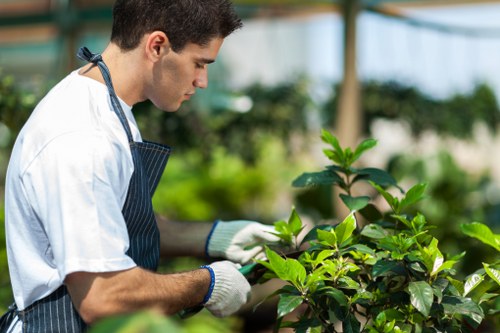 The risk assessment process follows a systematic approach: identify hazards, assess who might be harmed and how, evaluate and implement control measures, and monitor effectiveness. Control measures range from administrative steps like scheduling work at low-traffic times to engineering solutions such as blade guards, wheel chocks and mower stabilizers for uneven terrain. All tasks are re-assessed if site conditions change or after any near-miss or incident.
Documentation and record-keeping are vital components of the safety management system for grass-cutting businesses. Every job carries an associated risk assessment file, training records, PPE issue logs, and proof of public liability insurance. These records support continuous improvement and demonstrate compliance with regulatory requirements, whether for domestic lawn services, commercial turf maintenance, or municipal verge cutting.
Emergency preparedness is part of routine planning. Crews carry mobile first aid kits, communication devices and clear instructions for raising assistance. Incident reporting procedures ensure that any accident or near-miss during grass cutting is logged, investigated, and used to update risk assessments and training to prevent recurrence. This proactive stance strengthens safety culture and protects clients, staff and the public.
Choosing a grass maintenance or lawn mowing contractor that prioritizes insurance, staff competency, correct PPE and a robust risk assessment process reduces liability and increases client confidence. Our policy is to maintain high standards across all these areas so that every turf maintenance job ??? from simple grass trimming to complex grounds management ??? is carried out safely, professionally and with full accountability.

